Amazon’s 2025 Layoffs: What Happened, Why It Happened, and What It Means for Employees in an AI-First Era
In late 2025, Amazon made headlines once again — this time for a massive wave of layoffs that affected thousands of employees across departments and countries. What’s striking about this round of job cuts isn’t just the number of people involved, but the reason behind it: artificial intelligence. This wasn’t the typical “cost-cutting” story. It was about restructuring the company for an AI-first future — a move that reflects not just Amazon’s direction, but a global shift in how corporations operate and compete.
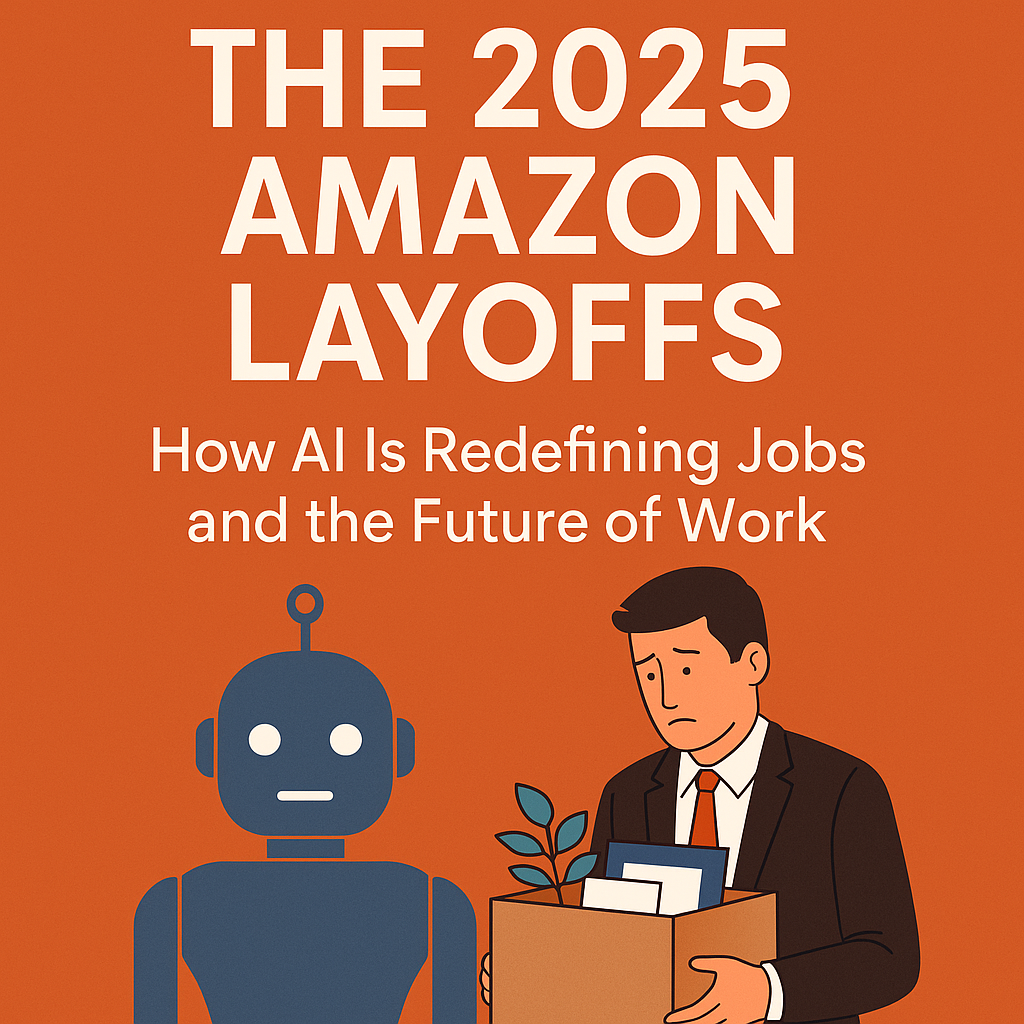
The 2025 Amazon Layoffs: How AI Is Redefining Jobs and the Future of Work
In late 2025, Amazon made headlines once again — this time for a massive wave of layoffs that affected thousands of employees across departments and countries. What’s striking about this round of job cuts isn’t just the number of people involved, but the reason behind it: artificial intelligence.
This wasn’t the typical “cost-cutting” story. It was about restructuring the company for an AI-first future — a move that reflects not just Amazon’s direction, but a global shift in how corporations operate and compete.
From Pandemic Boom to AI Realignment
During the pandemic, Amazon grew at lightning speed. Millions shopped online, cloud services soared, and hiring skyrocketed. But after the world reopened, the tech industry faced a different reality: slower growth, overstaffing, and the need to focus on profitability.
By 2023, Amazon had already reduced its workforce by around 27,000 people. It seemed like the restructuring was over — until 2025 came along. This time, the cuts were deeper and more strategic.
Instead of focusing on over-hiring or underperformance, the 2025 layoffs were about transformation. Entire divisions were restructured to make space for new AI-driven functions. Departments once managed by humans began integrating machine learning systems to perform tasks faster, cheaper, and with fewer errors.
Why AI Is at the Center of This Change
Amazon has always been a pioneer in automation — from warehouse robotics to recommendation algorithms. But 2025 marked a turning point. Generative AI and advanced automation tools began replacing not just routine manual tasks, but cognitive and managerial ones too.
-
In customer service, chatbots and virtual assistants powered by large language models now handle most inquiries.
-
In logistics, predictive algorithms can forecast demand, optimize delivery routes, and manage inventory more efficiently than teams of analysts.
-
In marketing and content creation, AI systems can generate copy, design visuals, and even test variations faster than human teams ever could.
For Amazon, this meant it could maintain — or even increase — productivity with a smaller workforce.
But for employees, this shift created uncertainty.
The Human Impact: Real People Behind the Numbers
Behind every number is a person — a career, a family, and a sense of belonging. The layoffs affected engineers, product managers, HR professionals, and even mid-level executives. Many had been with Amazon for years, helping it grow from an online bookstore into a global empire.
For those affected, Amazon offered a 90-day internal mobility window — time to apply for other roles within the company. But with AI-focused positions becoming the new priority, many found that their existing skills didn’t match the new requirements.
This marks a fundamental truth about the modern workforce: the value of a job is no longer in what you know, but in how quickly you can learn something new.
The Broader Message to the Tech Industry
Amazon’s restructuring is part of a larger trend sweeping across the tech world. Companies like Google, Meta, and Microsoft are also reorganizing their teams to align with AI strategies.
The new logic is simple: AI doesn’t just automate work — it redefines it.
Where there used to be five analysts, there might now be one data scientist supported by intelligent tools. Where a marketing team needed ten people, now two can handle the same output using AI-driven automation.
This doesn’t mean humans are obsolete. It means humans are being pushed toward higher-value work — creativity, strategy, judgment, and innovation — while machines handle the repetitive parts.
The Future of Work at Amazon and Beyond
For those who remain at Amazon, the future looks both exciting and demanding. The company is investing heavily in AI infrastructure, chips, and cloud platforms, aiming to lead the next wave of innovation.
This means the workforce will evolve rapidly:
-
Technical roles like AI engineers, data scientists, and product managers will grow.
-
Operational and administrative roles may shrink as automation spreads.
-
Hybrid roles will emerge, where humans work alongside AI systems — overseeing, improving, and guiding them.
The employees who thrive will be those who embrace continuous learning. In this era, adaptability is more important than seniority. Knowing how to prompt, evaluate, and collaborate with AI tools will be as essential as knowing how to use email once was.
Lessons for Every Professional
Amazon’s layoffs are a wake-up call for the global workforce. Here are a few key lessons:
-
AI literacy is no longer optional.
Every employee — from HR to finance — needs to understand how AI impacts their role. Learning to use AI tools effectively can make you indispensable. -
Reskilling beats waiting.
The pace of change means waiting for stability isn’t a strategy. Upskilling in areas like data analysis, machine learning basics, or AI ethics can open new doors. -
Emotional intelligence is your edge.
AI can mimic logic, but not empathy. Humans who lead with emotional intelligence, creativity, and ethics will always have value. -
Build a personal brand.
The best defense against uncertainty is visibility. Share your expertise, publish your ideas, and connect with your community. Being seen as adaptable and forward-thinking helps you stand out when industries shift.
The Human Side of Automation
While it’s easy to frame AI as the “villain” behind job losses, the truth is more nuanced. AI is a tool — powerful, transformative, but also neutral. It’s how organizations use it that defines whether it creates opportunity or causes harm.
For Amazon, the challenge will be balancing efficiency with empathy. For workers, the challenge is to grow alongside the technology — not be replaced by it.
As one former Amazon employee shared anonymously:
“AI didn’t take my job overnight. It slowly became part of it. Then one day, I realized I wasn’t the one driving the process anymore — the algorithm was.”
That’s the reality many professionals are waking up to.
What Comes Next
In the coming years, Amazon will continue hiring — but selectively. New jobs will focus on AI systems, robotics, sustainability, and cloud infrastructure. Fewer people will do more work, empowered by smarter technology.
This pattern won’t stop with Amazon. It will shape every industry, from banking to healthcare. The companies that thrive will be those that balance automation with humanity, ensuring that innovation doesn’t leave people behind.
Frequently Asked Questions
1. Why did Amazon lay off employees in 2025?
The company aimed to restructure its operations to focus more on artificial intelligence, cloud infrastructure, and efficiency. It wasn’t just about cutting costs — it was about aligning the organization with its future business priorities.
2. Were all departments affected?
No. The layoffs were concentrated in corporate functions such as HR, operations, and administrative layers. Technical and AI-focused teams were largely unaffected — and in many cases, they are still hiring.
3. Will there be more layoffs?
It’s possible. As AI integration deepens, more teams may be restructured. However, new opportunities will also emerge as Amazon expands its AI divisions.
4. What can current Amazon employees do to stay relevant?
Employees should focus on learning about AI, data analytics, automation tools, and how these technologies apply to their domain. Staying proactive and adaptable is the key to career longevity.
5. What’s the long-term effect on workers?
The long-term effect will depend on how quickly employees reskill. Those who adapt to AI tools will find new opportunities; those who resist may find themselves displaced.
Final Thoughts
Amazon’s 2025 layoffs represent a pivotal moment in the evolution of work. The message is clear: the future belongs to those who can work with machines, not against them.
The shift is difficult, and it’s deeply human to feel fear and frustration. But it’s also an invitation — to learn, reinvent, and lead in the next chapter of the digital revolution.
AI may be the engine, but human creativity, empathy, and adaptability remain the fuel. Those who understand that will not just survive this transformation — they’ll shape it.